爱情连连看
Chinese scientists complete comprehensive geological map of the moon_我的网站

A |
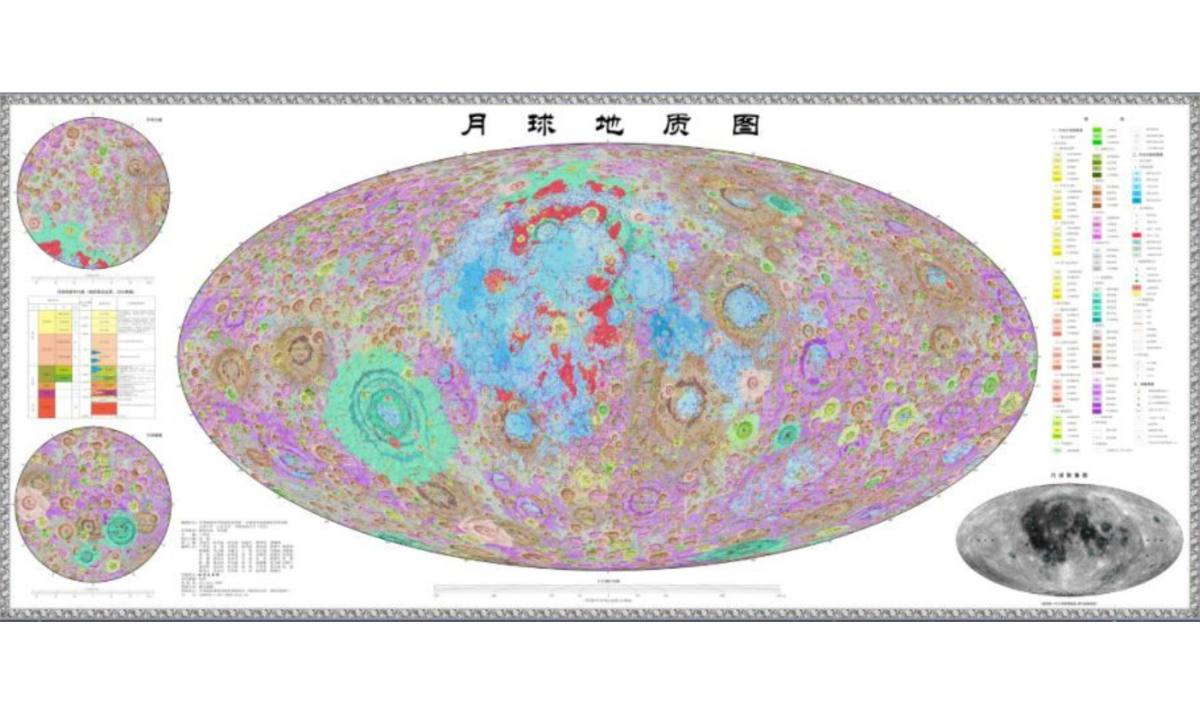
Photo: Xinhua
Using the latest data from the Chang'e lunar exploration program and other lunar exploration efforts, Chinese scientists have completed a 1:5,000,000 geological map of the entire moon, for the first time providing a more detailed global classification of the moon's late-stage geological layers and key scientific support for China's future lunar research station, landing site selection and deep-space exploration, while contributing to humanity's exploration on the Solar System's evolution, the Xinhua News Agency reported on Thursday.
Measuring approximately 280 centimeters in length and 120 centimeters in height, the lunar geological map includes detailed maps of the moon's polar regions, precisely identifying over 13,000 impact craters and 81 basins, while classifying 14 geological structure types and 17 rock types.
According to the map's compiling team from the Institute of Geology, Chinese Academy of Geological Sciences, the map has achieved systematic innovations in three key areas, based on the latest exploration data from the Chang'e lunar exploration program and other missions, and balancing scientific accuracy and accessibility.
The map updates the moon's geological timescale, revising the starting ages of key periods. The starting ages of the Aitkenian Period and the Nectarian Period have been adjusted to 4.33 billion years and 4.17 billion years, respectively, while the starting age of the Imbrian Period has been slightly revised to 3.92 billion years. This map for the first time provides a more detailed global classification of the moon's late-stage geological layers.
The map also updates the moon's material inventory with high-resolution mineral distribution data and improved rock classifications. Findings from the Chang'e-4 and Chang'e-6 missions led to the identification of gabbronorite in the South Pole-Aitken (SPA) Basin, offering new insights into the moon's deep interior.
The map introduces a customized visualization system for its 1:5,000,000 scale. To meet the requirements of the 1:5,000,000-scale mapping, researchers established differentiated minimum representation scales for various geological features. This ensures that the large-scale map maintains overall readability while preserving key geological characteristics of major scientific significance.
According to Yang Zhiming, director of Institute of Geology, the newly released lunar geological map will support China's future lunar research station, landing site selection, and deep-space exploration, while contributing new Chinese insights into the study of Solar System evolution.
Global Times
。 耶鲁大学生态学和进化生物学教授、该论文的资深作者Erika Edwards说:"这是一种非常罕见的性状组合,创造了一种'超级植物'--一种可能对作物工程等工作有用的植物。"植物已经发展出一套多样化的过程来加强光合作用,这是绿色植物利用阳光从二氧化碳和水合成营养物质的过程。

B | 例如,玉米和甘蔗进化出了C4光合作用,这使得植物能够在高温下保持生产力。琥珀类植物,如仙人掌和琼花,有另一种光合作用,称为CAM光合作用,这使它们能够生活在沙漠和其他干燥地区。C4和CAM有不同的功能,然而它们都使用相同的生化途径,作为传统光合作用的"附加物"。马齿苋的独特之处在于它同时表现出这两种进化的适应性,使它既能高产又能耐旱,这对一种植物来说是不寻常的组合。大多数科学家认为,C4和CAM在马齿苋的叶子里分别独立运作。不过,由共同通讯作者和博士后学者Jose Moreno-Villena和Haoran Zhou领导的耶鲁大学团队,对马齿苋叶片内的基因表达进行了空间分析,发现C4和CAM活动是完全整合的。它们在同一个细胞中运作,甚至是顺序进行:CAM反应的产物被C4途径处理。这个系统在干旱时期为C4植物提供了不同寻常的保护。研究人员还建立了代谢通量模型,预测了一个综合的C4+CAM系统的出现,反映了他们的实验结果。作者说,了解这种新的代谢途径可以帮助科学家设计新的方法来设计玉米等作物,以帮助抵御长时间的干旱。Edwards说:"就在C4作物(如玉米)中设计CAM循环而言,在成为现实之前,仍有许多工作要做。

C | 但是研究结果已经表明,这两种途径可以有效地整合并分享产品。C4和CAM比我们想象的更加兼容,这使我们怀疑还有更多的C4+CAM物种,等待我们去发现。
Current article:http://tj5.runtunpaixufenjuduishuang.pics/34px/h0rh.html
Published on:00:00:00